My Own Private Rosetta Stone
Family history work can be deeply frustrating and, now and then, richly rewarding in ways you never forget. This article follows one of those moments: a lone 1796 page from the Chauga Creek Baptist Church records in Franklin County, Georgia, that revealed the linked stories of four lives.
What This Article Covers
- The ups and downs of genealogical research
- A 1796 Chauga Creek Baptist Church record as a personal "Rosetta Stone"
- Four names: James Blair, David Barton, William Wilburn, and John Cleveland
- Kinship ties, Cherokee history, and the Trail of Tears
- Why history still matters today
The Hard Work Behind the Discoveries
Historical and genealogical research and writing at ARC takes patience, much like my other work as an organic beekeeper and gardener. Some moments are humbling: a person I have spent many hours researching turns out to be someone else entirely — a different individual who shares the same name, such as John Reid. When that happens, the whole narrative has to be rebuilt so the truth can be told. Such revisions are part of the craft of weaving together genealogy, public history, and kinship studies, and I don't resent them.
Alongside the frustrations come profound joys. They may come less often than the revisions, but when they do they feel like a sudden rainstorm after six months of drought. They deepen my appreciation for what explorer William Clark wrote in 1805 upon first seeing the Pacific after months of hardship: "Ocean in view! O! The joy!" As a native Texan, I may exaggerate slightly — but not by much.
A Single Page That Changed Everything
One of those peak research experiences came when I found a single page from the old handwritten records of the Chauga Creek Baptist Church of Franklin County, Georgia. I obtained the church records on microfilm from Furman University in Greenville, South Carolina. The page dates from 1796 and belongs to a longer membership list from that year. Seeing four specific names listed together in consecutive order made my pulse quicken. I already knew who these men were and a fair amount about them, but this particular grouping struck like lightning, briefly illuminating the long corridor connecting past, present, and future.
That page has become a personal "Rosetta Stone," a master key for deciphering mysteries of my own family's history and, by extension, some mysteries of early American history around 1800. Below I describe the interwoven stories of the four men named on that paper. Charles Bond, Clerk of the Chauga Creek Baptist Church, wrote these records with a feather ink pen; I read his cursive writing 224 years later on microfilm scanned by a computer, shipped via Interlibrary Loan from the Furman University archives to the Cline Library at Northern Arizona University in Flagstaff.
The Four Names on the 1796 Church Record
- James Blare (Blair)
- David Barton
- William Wilburn
- John Cleveland
James Blair
James Blair was a 19-year-old horseback messenger shot in the shoulder on his way to the pivotal Battle of Kings Mountain during the American Revolution in 1780. Ensign Blair still delivered his message and took part in the battle, a major victory for the rebellious United States. Sometime after the Revolution he moved from North Carolina to the Tugaloo River area along the South Carolina/Georgia border, where he became a close friend and business partner of James Vann, a wealthy mixed-blood Cherokee entrepreneur and headman. In 1801 Vann invited German-speaking Moravian missionaries to establish a school and mission at Diamond Hill, his slave plantation in the Cherokee Nation in what is now northern Georgia. Vann and Blair were also partners in the lucrative slave trade.
Colonel Blair, as he was later called, had several children with his two white wives and three known children with two Cherokee women. One daughter was born out of wedlock with the Cherokee wife of his friend John Ward. George Blair, one of his mixed-blood children, married two sisters who were daughters of Jonathan Blythe, a white man, and his mixed-blood Cherokee wife. George Blair was among the roughly 12,000 Cherokees who survived the Trail of Tears; one of the Blythe sisters died on the forced march west, among the approximately 4,000 Cherokees who "cried and died." Jonathan Blythe was a direct ancestor of William Jefferson (Blythe) Clinton on his white side — Hillary Rodham's husband has no Cherokee blood but does have ancestral connections to prominent Cherokees such as the Blythes.
David (Oldham) Barton
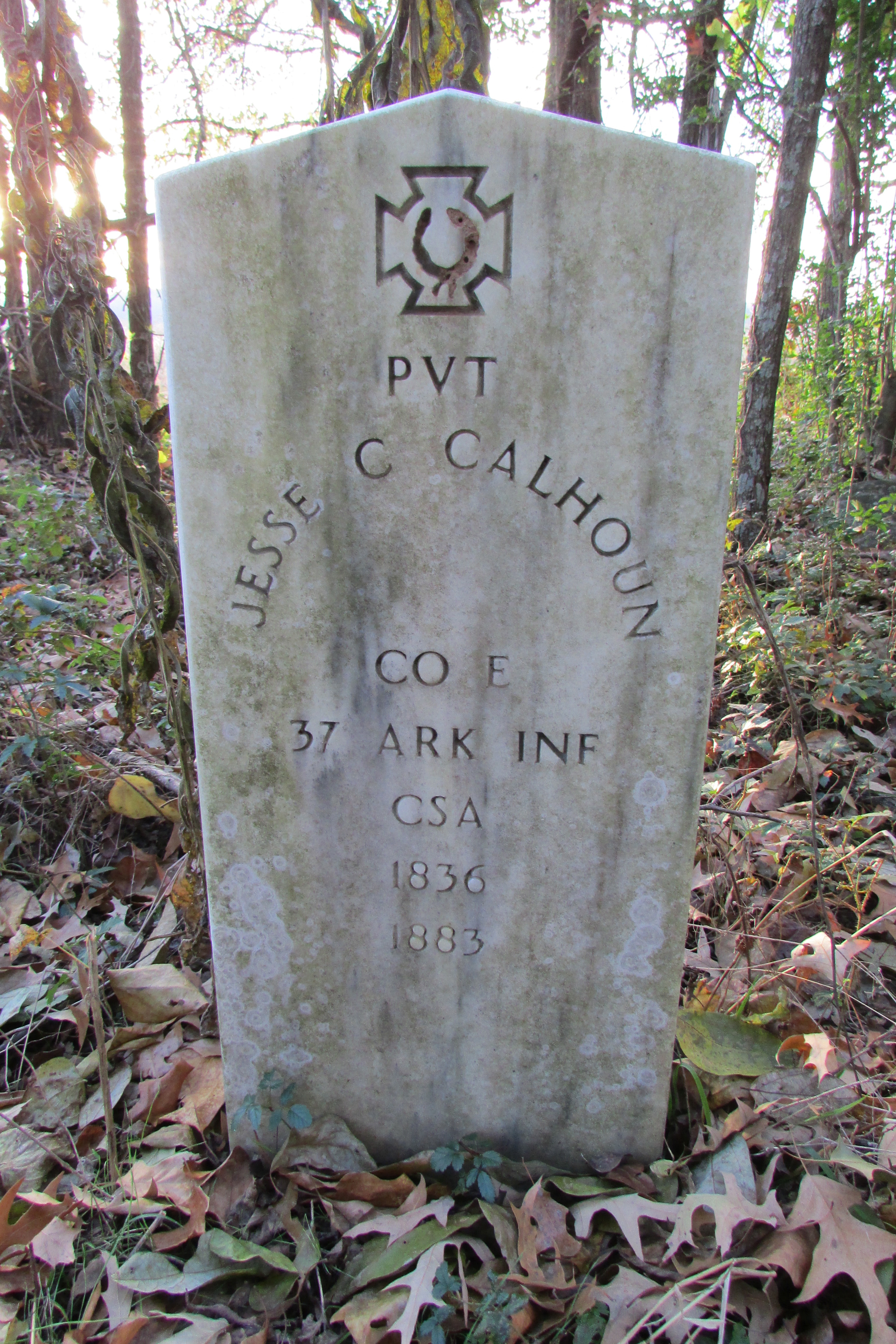
David Oldham Barton was the grandfather of Private Jesse Calhoun, Arkansas, CSA, who is buried alongside several of my Gentry relatives in a small family graveyard near Wolf Creek/Antoine, Arkansas. Next to Jesse's tombstone are the graves of two brothers, William Carroll Gentry and John Hamley Gentry. Their niece Martha Ann Gentry (b. 1846) is one of my sixth maternal grandmothers. Martha Ann Gentry was of Cherokee descent: her great-grandmother was Delilah Gentry, maiden name likely Vann, meaning Delilah was a close blood relative of James Blair's good friend and business partner James Vann. Delilah's biological father, John Vann III (the Interpreter), was the clan father — maternal uncle — of James Vann, which would make Delilah and James Vann members of the Blind Savannah/Wild Potato Clan. James Vann's first daughter was named Delilah, born in 1785; in 1801 she married a Scots American named David McNair in Knox County, Tennessee. In 1989 I also married a Scots American in Knox County, Tennessee, knowing none of this history at the time.
In 1777, 16-year-old James Blair purchased a swingletree at the estate sale of David Barton, Jesse Calhoun's great-grandfather. The Blairs were good friends of the Barton family in Wilkes County, North Carolina, then a British colony. David Oldham Barton's father, David Barton, was supposedly killed by Indians — probably Shawnees, if true — while exploring the Cumberland Gap in Caintuck (Kentucky). Barton Hills Elementary School in Austin, Texas, is the school I graduated from before junior high; I attended the fourth and sixth grades there. That school and other Austin places such as the famous Barton Springs are named for William Barton, one of the earliest pioneers to settle the Texas Hill Country and a close cousin of David Oldham Barton. "Billy" Barton's older brother was also named David Barton.
William Wilburn
William Wilburn also purchased an item at David Barton's estate sale in 1777. He was a resident of Wilkes County and a good friend of the Bartons and Blairs, and at least three of his siblings married older siblings of David Oldham Barton. In 1796 Wilburn apparently gave Delilah Vann and her husband Tyree Gentry their first known land parcel in Franklin County, Georgia, on the Tugaloo River near "Hatton's Ford" — a 150-acre portion of Wilburn's original 200-acre land grant from the state of Georgia, received as payment for services rendered.
Keep Exploring
Browse the rest of the site to discover more about our research and the services we offer.
Home Blog Who We Are What We Do Services Time: When? Place: Where? Colibri WPEach of these four men left traces that connect family lines, Cherokee kinship, and the early American frontier. Following a single record — a church membership list, an estate sale, a land grant — can open doors to stories that reach far beyond one surname. If you are tracing your own ancestors, the pages on this site show how that work is done.